Join our mobile Rapid Response Network!
You can be the first to hear about how we’re going to hold this administration accountable and how you can fight back for wildlife!
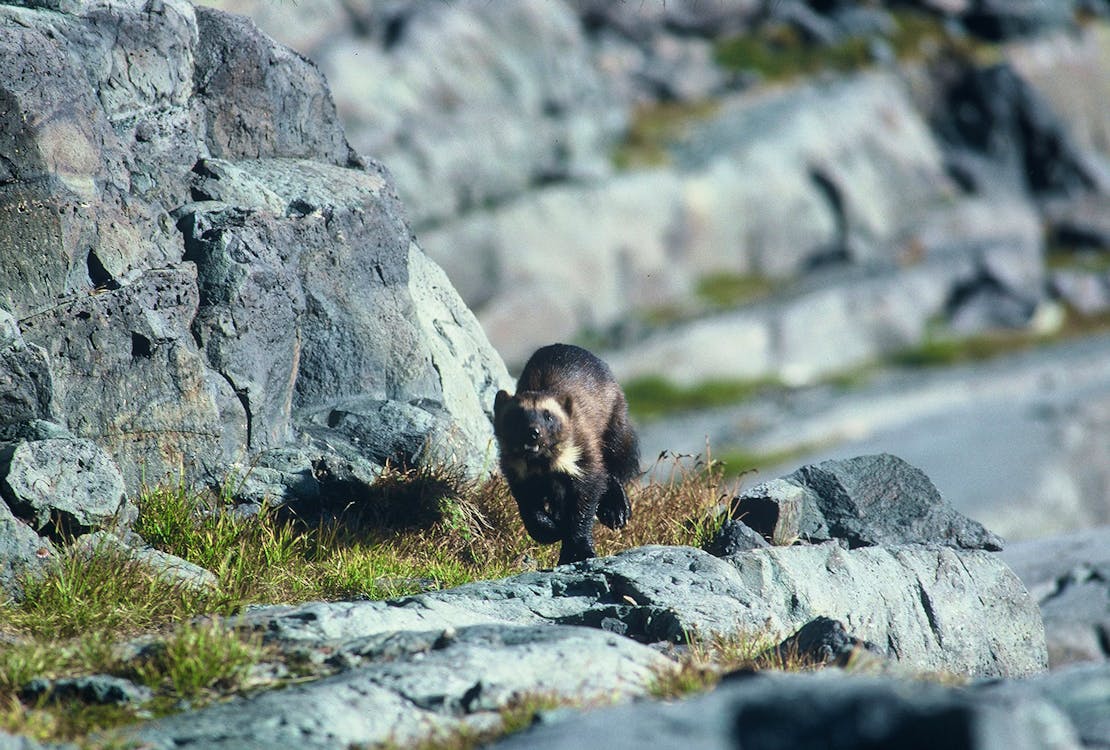
Typically weighing less than 35 pounds, the wolverine is the largest terrestrial member of the weasel family, Mustelidae.
They are powerfully built and have short legs with wide feet for traveling across the snow. Wolverines require deep snow to dig dens for their young. As highly effective scavengers of carrion, these animals are a vital part of their ecosystem.
Why are wolverines threatened?
The species is rare and faces significant challenges to its future in the continental United States. Due to their limited numbers, huge individual territories and remote locations, it is difficult to gather data on wolverines. This poses a challenge to scientists, agencies and others trying to understand wolverines’ habitat requirements, threats to their survival and pathways to recovery.
One thing, however, is clear: as a species dependent on deep snowpack for denning and foraging, the survival of wolverines in the Lower 48 is very much at risk due to the foreseeable effects of human-caused climate change.
After 23 years of advocacy, wolverines were listed as threatened under the Endangered Species Act in 2023.
Threats to wolverines include habitat loss and fragmentation, climate change and some trapping.
Threatened in the Lower 48.

Defenders' Impact
Defenders and our colleagues filed a petition with the U.S. Fish and Wildlife Service in 2000 requesting protection for the species under the ESA. We then took legal action in 2005 and 2008 when the agency did not move forward to protect the species. In 2010, the FWS determined wolverines did in fact warrant protections under the ESA, but the agency was unable to take further action until higher priorities were addressed. Then in 2011, FWS agreed in a multi-species legal settlement that wolverines in the contiguous U.S. would be reconsidered for listing. Finally, in November 2023, the FWS listed wolverines in the contiguous U.S. as threatened under the ESA.
To increase capacity for research, Defenders led a five-year project to recruit and train volunteer “community scientists” to document wolverines in the West using snow-tracking, hair (DNA) collection and remote cameras. These data points provide scientists with important information about the location of wolverines. Defenders is exploring opportunities to revive and expand this program in the coming years.
Now that federal protections for wolverines are secured, Defenders and our partners are working to ensure the restoration of wolverines to Colorado, a critical remaining stronghold of suitable but unoccupied wolverine habitat. In 2024, our team worked diligently to ensure the passage of a widely supported, bi-partisan bill in the state legislature that allows Colorado Parks and Wildlife to begin planning and eventually implement a wolverine reintroduction program. In the coming years, Defenders will work collaboratively to increase public awareness of wolverine conservation and build support for their return to Colorado.
What You Can Do
Vote for and promote candidates and policies that will make meaningful reductions in greenhouse gas emissions and fight climate change. Oppose legislation and candidates who would strip wolverines of federal protection. Advocate for the reintroduction of wolverines to Colorado and support Defenders work on the ground to save wolverines.
About
Wolverines in the Lower 48 live in rugged, remote country, spending most of their time in high elevations near or above timberline. Further north in Alaska and Canada, wolverines occur within a wide variety of elevations in alpine, boreal and arctic habitats, including boreal forests, tundra and western mountains. Today, wolverines in the Lower 48 can be found in portions of the Northern Cascades in Washington and the northern Rocky Mountains in Montana, Idaho and Wyoming.
Although it is difficult to count precisely the elusive wolverine, the estimated population in the lower 48 is fewer than 350.
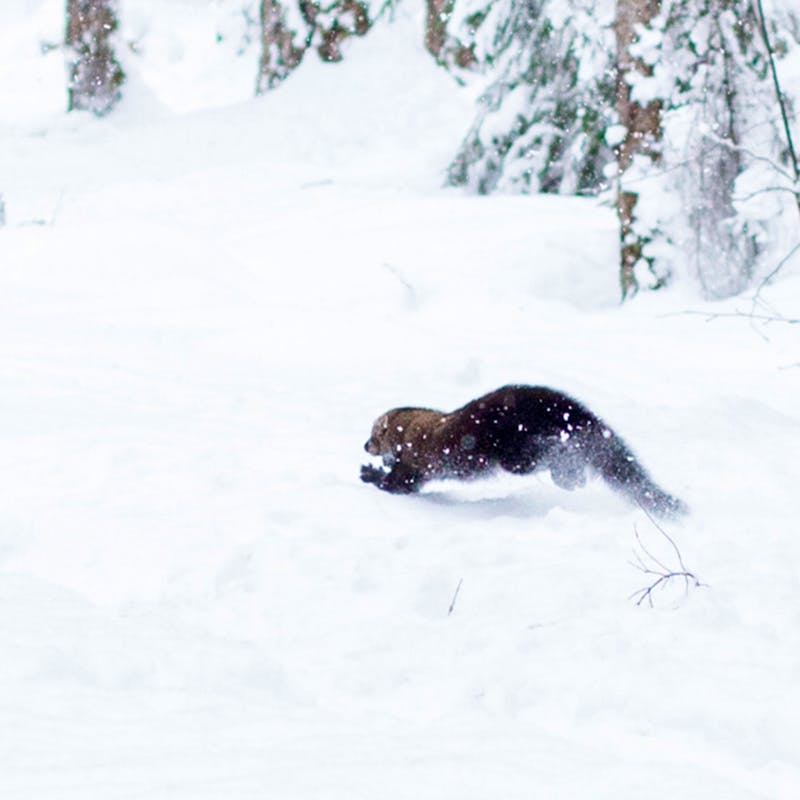
Wolverines do not hibernate and are well-adapted for winter existence. Their large snowshoe-like paws allow them to stay on top of deep snow, and their crampon-like claws enable them to climb up and over steep cliffs and snow-covered peaks.
Female wolverines give birth in winter in dens that provide security and a buffer to cold winter temperatures. These dens are generally tunneled through snow and are associated with uprooted trees, avalanche debris and boulders, often in remote alpine cirques at or above tree line. Young wolverines are called kits and are born white as snow.
Mating Season: Late spring to late summer
Gestation: Egg implantation is delayed until the following winter or spring, followed by a 30-to-45-day gestation period.
Litter Size: One to five kits, with an average in North America of one to two kits.
Wolverines are opportunistic feeders and eat a variety of foods depending on availability. In the winter they primarily scavenge dead animals. In the summer, their diet consists mainly of smaller mammals like porcupines, hares, marmots and ground squirrels. They can also occasionally take down much larger animals, including caribou and moose, when circumstances such as deep snow are in their favor.
Read More About the Wolverine
News