Join our mobile Rapid Response Network!
You can be the first to hear about how we’re going to hold this administration accountable and how you can fight back for wildlife!
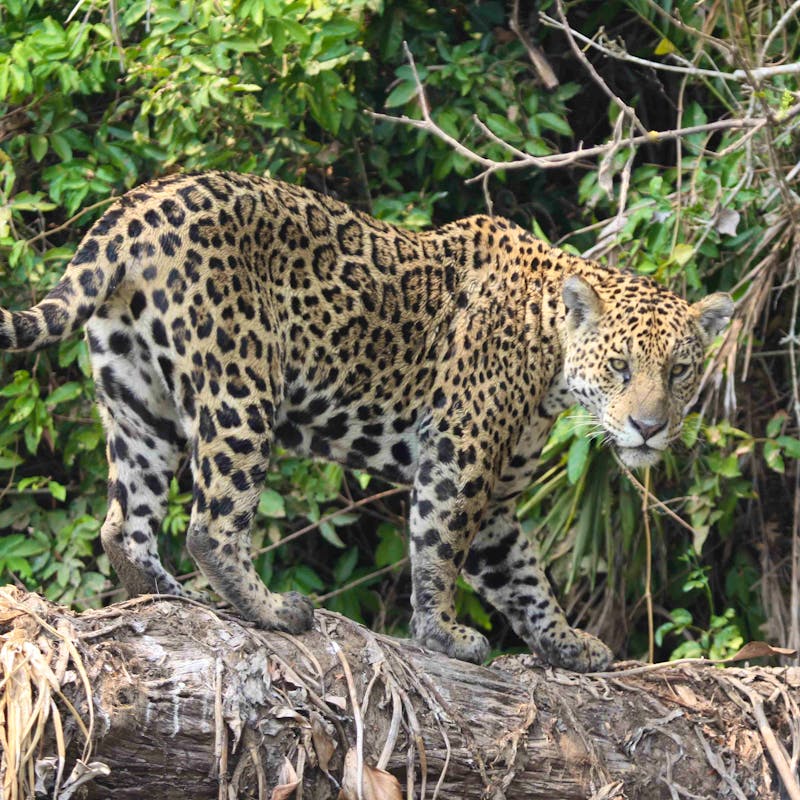
The jaguar is the largest cat in the Americas.
As a top-level carnivore, this big cat helps maintain ecological balance by regulating prey numbers and competing with other, smaller carnivores. Jaguars are also important in human culture, frequently playing a central role in stories, songs and prayers of Indigenous people.
Why are jaguars imperiled?
Yet today, jaguars have been all but eliminated from the United States. The big cats lived for hundreds of years in the central mountains of Arizona and New Mexico but were driven to local extinction by the mid-20th century, in part because of killing by government hunters. Populations in Central and South America are falling because of habitat destruction, trade of jaguar parts and products and conflict with humans.
For jaguars to make a comeback in the U.S., the U.S. Fish and Wildlife Service must follow science, undertake translocations and revise its recovery plan to support the restoration of jaguars to the full array of ecological settings that they occupied before they were eradicated.
Jaguars are killed because of perceived conflicts with livestock and overhunted for trophies and as a substitute for tiger bones in Asia. Habitat loss is also a big problem for the northern population and the U.S.-Mexico border wall threatens to block jaguar migration routes.

Defenders' Impact
Defenders played a key role in helping establish the Northern Jaguar Reserve in Sonora, Mexico, to protect the northernmost remaining jaguar population. Today, we are advocating for FWS to reestablish a breeding population, based on recent scientific understanding and to adopt more meaningful recovery criteria to help the jaguars recover in a greater portion of their range in the Southwest. This includes evaluating all potential jaguar habitat in its historic range in the U.S, including north of Interstate 10.
Defenders authored two new science papers in 2021 that opened the possibility of jaguar restoration to the U.S. The first paper suggested an area in central Arizona and New Mexico spanning 20 million acres — roughly the size of South Carolina — can provide potentially suitable habitat for 90 to 150 jaguars. This area was not considered in the 2018 FWS Recovery Plan for the jaguar.
The second paper provided a framework for reintroducing jaguars into the U.S., righting the wrong done to “America’s Great Cat” more than 50 years ago. Defenders is advancing innovative, community-based non-lethal methods for lessening human-carnivore conflict, such as the use of range riders and fladry, techniques which may work for jaguars. We are also vigorously fighting the construction of a U.S.-Mexico border wall between that would block jaguar migration between the countries and viable habitat.
What You Can Do
Raise your voice in opposition to the border wall and in favor of policies that will bolster and protect jaguar populations and their habitat. Buy responsibly: avoid palm oil and threatened rainforest woods and only purchase shade grown coffee and sustainable cocoa. Reduce your carbon footprint.

About
The jaguar once roamed from Argentina, South America, all the way up to the Grand Canyon in Arizona, U.S. Today, jaguars have been almost completely eliminated from the U. S. and are endangered throughout their range, which stretches down to Patagonia in South America.
Jaguars make their homes in a wide variety of habitats including deciduous forests, rainforests, swamps, pampas grasslands and mountain scrub areas. Because they are habitat generalists, they can thrive almost anywhere there is food and they’re not persecuted.
The total population of jaguars in the Americas is approximately 64,000. There are 34 jaguar subpopulations, 25 of which are threatened and eight of which are in danger of extinction.
Jaguars are solitary animals, living and hunting alone, except during mating season. They hunt mostly on the ground, but sometimes climb a tree and pounce on their prey from above. Unlike most big cats, jaguars love the water.
Kittens stay with their mother from 1 to 1.5 years.
Mating Season: Occurs year-round
Gestation: 90-110 days
Litter size: One to four kittens
Jaguars are known to eat deer, peccary, crocodiles, snakes, monkeys, deer, sloths, tapirs, turtles, eggs, frogs, fish and anything else they can catch.
Featured

An Iconic Big Cat: Fun Facts About Jaguars
Read on to gain a better understanding of this iconic cat, including how big jaguars are, where jaguars live, what jaguars eat and why this legendary cat needs our help.
Read More About the Jaguar
News