Join our mobile Rapid Response Network!
You can be the first to hear about how we’re going to hold this administration accountable and how you can fight back for wildlife!
Beluga whales are highly social, gregarious animals.
They squeal, squeak and chirp, which is why sailors long ago called them “sea canaries.” Of the five Alaskan stocks, the Cook Inlet beluga stock is the smallest and most isolated from other beluga whales. This population has declined over an estimated 75% and the National Oceanic and Atmospheric Administration (NOAA) listed it as endangered in 2008. The most recent status report is that only 331 Cook Inlet belugas remain.
Why are Cook Inlet beluga whales endangered?
The Cook Inlet Beluga whale was listed as endangered by the National Oceanic and Atmospheric Administration in 2008. The most recent status report is that only approximately 331 Cook Inlet belugas remain – a 75% drop from its historic estimated population of 1,300.
Cook Inlet belugas were once a valuable part of the regional Alaska Native subsistence diet, but their population has declined rapidly. NOAA believes this was most likely due to unregulated hunting at a level that this small population could not sustain. Although the hunt has been suspended since 2005, the whale population has not recovered as expected and Defenders and others continue to work with NOAA and other partners to understand what is limiting its recovery.
Defenders is working to address multiple threats to Cook Inlet beluga recovery including noise and physical habitat changes associated with construction projects and oil and gas development, changes in prey availability, pollution and vessel traffic.
Defenders' Impact
Defenders of Wildlife has been fighting for Cook Inlet beluga whales for years. We and our partners petitioned to get the Cook Inlet beluga whale listed as an endangered species in 2007 and pushed for designation of over 3,000 square miles of critical habitat in April 2011. We helped develop the Cook Inlet Beluga Recovery Plan and serve on the Outreach committee of the Recovery Task Force.
Defenders is a partner of the Alaska Beluga Whale Monitoring Partnership. We are working with citizen scientist volunteers to monitor belugas at multiple locations throughout Cook Inlet. We cohost the most industrialized site in the Inlet, Ship Creek, located at the Port of Alaska.
Defenders serves on the Outreach Committee of the Cook Inlet Beluga Recovery Task Force. We also track and comment on projects and activities that may impact recovery efforts. Along with Friends of the Anchorage Coastal Wildlife Refuge, we helped fund and launch the Anchorage Coastal Beluga Survey in 2008, and in 2017 we helped create the popular annual ‘Belugas Count!’ program to engage and inform local residents about Cook Inlet belugas.
What You Can Do
Check out the Recovery Plan for Beluga Whales. Participate in community science projects like the Photo ID Project and ‘Belugas Count!’ to help monitor beluga whales. Report any stranded beluga whale to the Alaska Marine Mammal Stranding Network, (877) 925-7773. Provide input to NOAA or other agencies and to your elected state and federal representatives on proposed actions in beluga habitat that may impact their recovery.

About
Beluga whales are distributed throughout seasonally ice-covered arctic and subarctic waters. Genetic research has determined that there are five beluga whale populations within U.S. waters: Cook Inlet, Bristol Bay, eastern Bering Sea, eastern Chukchi Sea and Beaufort Sea.
Most recently, scientist determined in 2023 that the Cook Inlet beluga population size is between 290 and 386 animals, with a most likely median estimate of 331 animals.
Belugas congregate and travel in groups of two or three to as many as several hundred. Some are migratory within their limited range, while others remain residents of a particular area.
Belugas use sound, or echolocation, to find their prey. They also use sound to communicate and navigate by producing a variety of clicks, chirps and whistles.
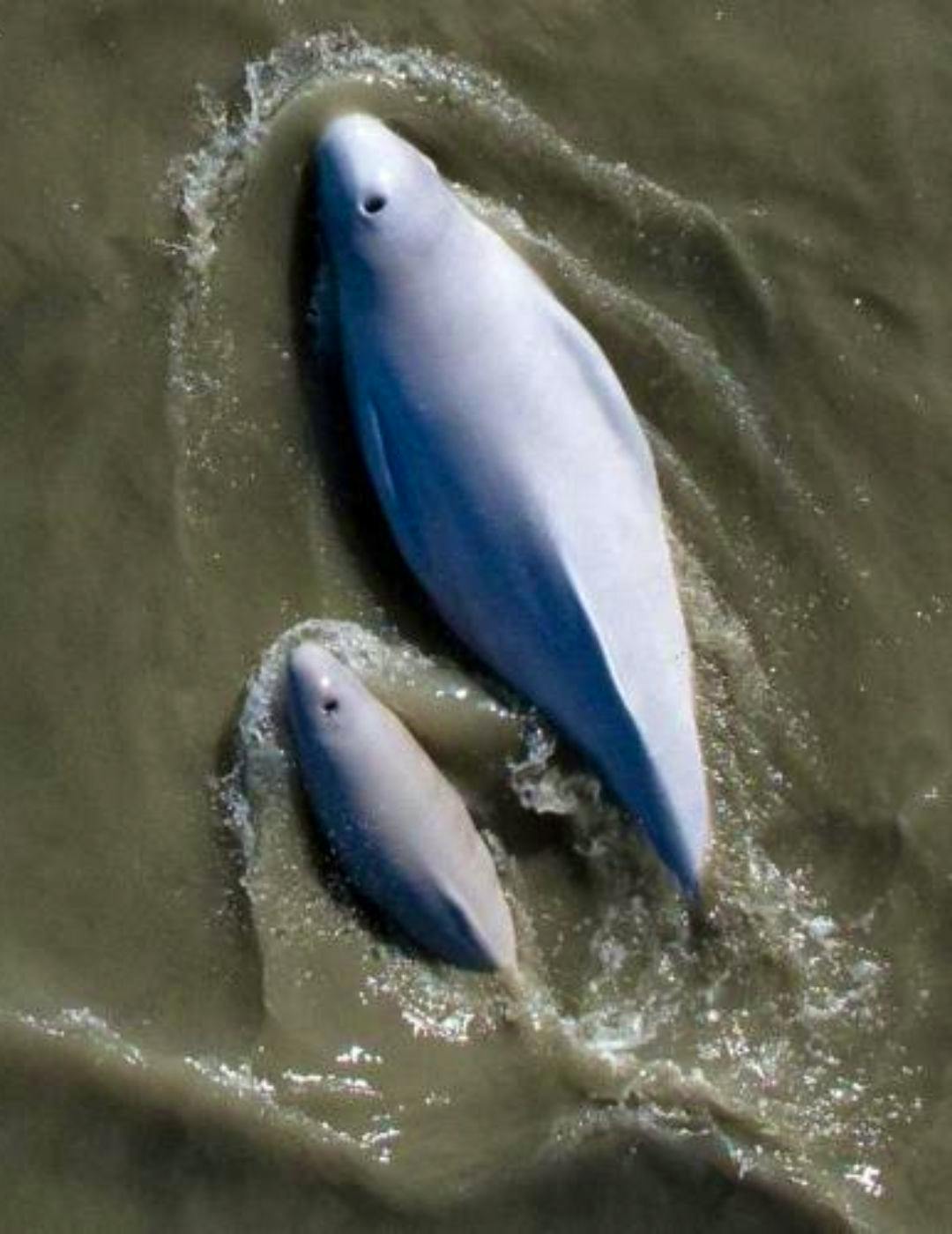
Young belugas are usually dark grey in color. The grey steadily lightens as they mature - reaching their permanent white color by the age of seven for females and nine for males. Calves nurse for about two years.
Mating Season: Late winter - early spring
Gestation: 15 months
Number of offspring: 1 calf is born at a time. But it is not uncommon to see a mother with a mix of younger and older siblings.
Beluga whales are opportunistic feeders in the water column and on the seabed – they can dive to at least 2,000 feet. They feed on salmon, eulachon, tomcod, smelt, char, rainbow sole, whitefish, saffron and arctic cod, herring, shrimp, mussels, octopus, crabs, clams, mussels, snails and sandworms.
Read More About the Beluga Whale
News