Transnational species at risk under Trump administration policies
By Jane Braxton Little
It begins when the skies over the Beaufort Sea glint gray with the hint of snow. The caribou that have been fattening on the cotton grasses of Alaska’s northern coastal plain become restless, stirred by a communal awakening that urges them south. They shift slowly at first. But when freezing sleet falls they travel with purpose, a musk-scented tide of mammals moving out of Alaska into Yukon Territory, heading across Old Crow Flats toward winter range south of the Porcupine River.
 When the Porcupine caribou herd passes by, one animal after another, 200,000-animals strong, the pounding of their four-toed hooves on frozen ground is haunting, says Bernadette Demientieff, executive director of the Gwich’in steering committee formed to fight threats to the herd. “You feel it in your bones and you feel it in your heart.” It’s an age-old migration, and at 1,500 miles it’s one of the longest in the world. “This is the only place they know and they’ve known it for two million years,” she says.
By the time they reach the Porcupine River, the herd will have meandered back and forth countless times between Canada and the United States. Summer grazing takes them where the foraging is best and pesky insects fewest without regard to national borders. Winter storms compel the herd south from their calving grounds in the Arctic National Wildlife Refuge in Alaska through the Yukon in Canada to Alaska’s more protective boreal forests.
Since 1987 this transboundary species has been protected by a formal agreement between these neighboring nations. Designed to conserve the Porcupine herd, the agreement also expands bilateral cooperation to the Gwich’in and others who have traditionally depended on the herd. International treaties have protected trans-border species like the Porcupine caribou for over a century. When no single country has authority over a species’ habitat, neighboring nations have collaborated, forming agreements to protect thousands of different North American animals. Together these partners have relied on science and deeply committed cooperation to weather the political tensions that occasionally erupt.
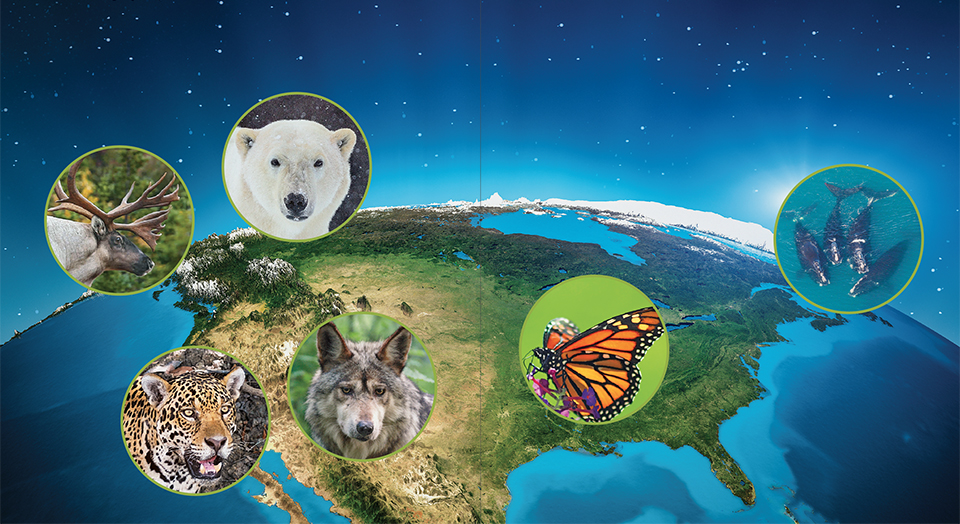
Today these accords face a barrage of proposed changes and U.S. policy interpretations in what may be their most challenging tests to date. How Canada, Mexico and other treaty partners handle current Trump administration proposals could affect the very existence of numerous species. Among the most fragile are:
-
Jaguars—nearly extirpated in the United States, these wild cats are still crossing back and forth over the Mexican border, protected by the Endangered Species Act (ESA) and the Convention on International Trade in Endangered Species.
-
Monarchs—on their five-stage migration from the forests of Mexico to southern Canada, these butterflies are protected by the trinational North American Agreement on Environmental Cooperation and other treaties.
-
Polar bears—after hunting pressure threatened the bears’ survival, Canada, Denmark, Norway, Russia and the United States signed the 1973 International Agreement on the Conservation of Polar Bears, which also holds member nations accountable for habitat protection.
Without a treaty to protect them, endangered North Atlantic right whales are also in precarious shape, and their survival demands international cooperation. Fewer than 450 of these marine mammals remain, and scientists say they may be only 20 years from functional extinction. Last year took a horrific toll as they migrated along the Eastern Seaboard of the United States and Canada. Seventeen right whales were confirmed dead—12 in Canada, five in U.S. waters. Even more alarmingly, no new calves were spotted this spring.
U.S. agencies have increased protections for this struggling population by setting speed limits for ships and strengthening regulations to reduce fishing line entanglements. For their part, Canadian officials have moved to implement similar measures. But for this whale to survive and recover, U.S. and Canadian officials need to redouble their efforts to protect them from lethal ship strikes and fishing gear that not only kill right whales directly but affect their ability to bear calves, says Jane Davenport, Defenders’ senior staff attorney. “The U.S. and Canada must work together to save this transnational species before it is too late,” she says.
None of the species these nations are trying to protect knows or cares about international borders. It’s up to the humans who established national boundaries to coordinate and cooperate—“so what we’re doing in Montana is consistent with and complements what’s happening across the border,” says Shawn Cantrell, Defenders’ vice president for field conservation.
Among the oldest of the North American treaties is the Migratory Bird Treaty Act (MBTA), a statute designed to implement treaties the United States now holds with Canada, Japan and Russia. When it was passed in 1918, migratory birds were in real trouble. The passenger pigeon had just gone extinct and the snowy egret, hunted for its delicate feathers to adorn ladies’ hats, appeared headed for a similar fate. At the 2016 centennial celebration of what began as a two-party agreement, U.S. and Canadian officials credited their predecessors with recognizing the “overwhelming need for collaboration” to protect species traversing their borders. “Our two countries’ conservation efforts have yielded real results,” Catherine McKenna, Minister of Environment and Climate Change Canada, said at the event.
The MBTA makes it illegal for individuals to pursue, hunt, take, capture, kill or sell any migratory bird. Over the last century it not only stopped the slaughter of snowy egrets but also established specific hunting seasons for game birds. Among the more than 1,000 bird species it has protected are cranes, cuckoos, hummingbirds, raptors and dunlins, an unheralded brown-backed shorebird that breeds in northern Canada and Alaska before migrating to Russia and Asia for the winter.
In 1970, U.S. prosecutors began holding industries responsible for incidentally causing bird deaths that could have been avoided. If companies refuse to comply with best- management practices—covering oil pits, for example, or locating wind turbines away from common flight routes—they may be taken to court. Thanks to the MBTA, Exxon paid $125 million in fines for the deaths of 36,000 birds caused by the 1989 Exxon Valdez oil spill, and BP paid $100 million for killing as many as 102,000 birds in the 2010 Deepwater Horizon spill. (Post-spill mortality assessments estimate the death toll actually exceeded a million birds.) At a time when climate change is altering and eliminating habitat and throwing feeding patterns out of sync, these additional protections have helped many species remain relatively stable.
Those safeguards for migratory birds were severely undermined in December when the Trump administration reinterpreted the law to free oil, gas and other industries from criminal prosecution and fines for negligent deaths. Revoking the threat of prosecution not only absolves the energy industry at the expense of birds, it may also threaten the 100-year-old act itself.
At trilateral talks held this spring, Canadian officials expressed concern that the U.S. Interior Department’s new interpretation of the act does not jibe with the long-accepted understanding of the treaty. The legal obligation extends to regulating the death of birds by industry operations, according to Canadian interpretation.
Jason Rylander, Defenders’ senior staff attorney, was more direct: “Trump’s interpretation is inconsistent with the collective understanding. For decades, both nations understood the MBTA to protect birds from incidental take but the Trump administration has now repudiated that interpretation. This is another example of how this administration’s big business bias is attacking fundamental principles of conservation that once received strong bipartisan and international support.” Defenders is challenging the administration’s move in court.
The MBTA was an early demonstration of how countries can find common ground and work together. It also recognized that the federal government is the appropriate party to regulate migratory species. Since then the United States has adopted numerous international treaties to protect wildlife, but its closest alliances are with neighbors Mexico and Canada.
When the North American Free Trade Agreement (itself a Trump target at press time) was ratified in 1994, it included a side accord establishing the Commission for Environmental Cooperation. Last year the commission adopted trilateral plans aimed at sustaining four species groups that include sharks and parrots. Wildlife agencies in the three nations also formed the Canada-Mexico-U.S. Trilateral Committee in 1996 to consolidate their efforts to conserve and manage wildlife and ecosystems.
One result of the close cooperative ties with Mexican wildlife officials is the revival of the Mexican gray wolf. Known as “el lobo,” this canid once roamed from central Mexico to the U.S. Southwest, preying mostly on deer and elk. By the mid-1970s the wild U.S. population had been wiped out. Mexico, however, still had gray wolves—“five, to be exact,” says Bryan Bird, Defenders’ Southwest program director. It was enough to launch a captive-breeding program that resulted in the 1998 release of 11 animals back into the wild in Arizona. Mexico has also released wolves from its remnant population, reporting the first wild wolf litter in 2014.
“The Mexican gray wolf is an example of a species with extremely limited population that might have gone extinct or been extirpated in one country or the other without international cooperation,” says Bird. “And while it’s not recovered yet, without the help of Mexico there was little chance of a wild population of el lobo north of the border,” Bird says.
Sometimes wildlife conservation interests may vary from international political alliances. “International tensions in relationships do not preclude very close working relationships in the conservation arena,” says Bob Dreher, Defenders’ senior vice president for conservation programs. For example, the United States and Russia have been closely aligned in protecting polar bear populations on both sides of the Bering Strait, while Canada and Denmark, which favor greater opportunities for subsidence hunting, are less in step. “Close political alliances do not guarantee conservation allies,” adds Dreher.
Despite the generally close cooperation among neighboring nations, a shadow is now looming over the future of international wildlife conservation in North America. Nowhere is that shadow more ominous than along the U.S.-Mexico border, where President Trump has promised to erect a “big, beautiful wall.” The 600 miles of barriers already in place have taken a heavy toll on wildlife by blocking movement, fragmenting habitat and hampering many species from shifting their range in response to climate change. Defenders has already filed several lawsuits and plans to litigate additional cases where construction has caused long-term damage and death to wildlife, says Rylander.
In other cases, the wall has caused outright habitat destruction. At the National Butterfly Center, a 100-acre privately owned preserve in Texas just north of the border, an unidentified crew with chainsaws and mowers arrived unannounced in 2017. They began removing the trees and shrubs painstakingly nurtured for more than 230 insect species in what is otherwise an expanse of sunflowers, cabbage and sugar cane—crops that do not support wildlife. Executive Director Marianna Trevino-Wright says she has never been told who these people were other than “workers preparing for the border wall.” And while the work has stopped for now, she says federal agents told her they will eventually return and bulldoze everything. “They said there is no reason to have even one bush for something to hide under,” Trevino-Wright told me.
Beyond physical dangers, the wall poses an ominous intangible threat: Decades of cooperation with Mexican wildlife agencies and organizations are starting to erode. Trump’s bombastic rhetoric is sending an antagonistic message to Mexican agencies, scientists and conservationists, according to a recent Defenders’ report, “In the Shadow of the Wall.” “The wildlife successes these neighboring nations have enjoyed have depended on partnerships and binational cooperation, but the current tensions between our countries have strained that relationship,” says Dreher. “They are our close allies, not the enemy. But the wall is threatening to separate us as much as it separates wildlife that need to get across the border.”
Similar tension is building on the northern border. The Trump administration announced in April the beginning of a planning process that could lead to oil and gas exploration and drilling in the Arctic National Wildlife Refuge—calving grounds for the Porcupine caribou herd. Canadian officials have raised this as an issue of concern under the bilateral treaty to manage the herd, and they oppose opening the area to resource development, says Amelie Desmarais, a spokesperson for Environment and Climate Change Canada. Beyond caribou concerns, the push to drill adds pressure to the existing unease with Canada over Trump’s interpretation of the MBTA and calls into question U.S. obligations to protect polar bear habitat under the Agreement on the Conservation of Polar Bears.
Breaching international agreements can have real consequences for wildlife, says Juan Carlos Cantu, Defenders’ Mexico program manager. “If one nation does not comply with or tries to weaken established regulations, the whole agreement is useless,” he says. “It’s back to only one nation doing the work, which is difficult.”
By late fall caribou throughout the Arctic will be on the move again, crossing mountains and plains without regard to human borders. Most of these herds are in decline, some by as much as 80 percent. The Porcupine herd is an exception and a beacon of hope bolstered by three decades of international cooperation.
For the Gwich’in, upholding this agreement means more than relationships among neighboring nations. Their identity, culture and collective memory are invested in the herd, says Demientieff. “The Gwich’in Nation is both Canada and Alaska. We speak with one voice, and we speak for the herd. We will stand strong in unity for our future generations.”
Jane Braxton Little writes about science and the environment for publications that include Scientific American, National Geographic and High Country News.
For more, visit defenders.org/transboundary.
Only select articles from Defenders are available online. To receive 4 issues annually of the full award-winning magazine, become a member of Defenders of Wildlife!