Basic Facts About Arctic Foxes
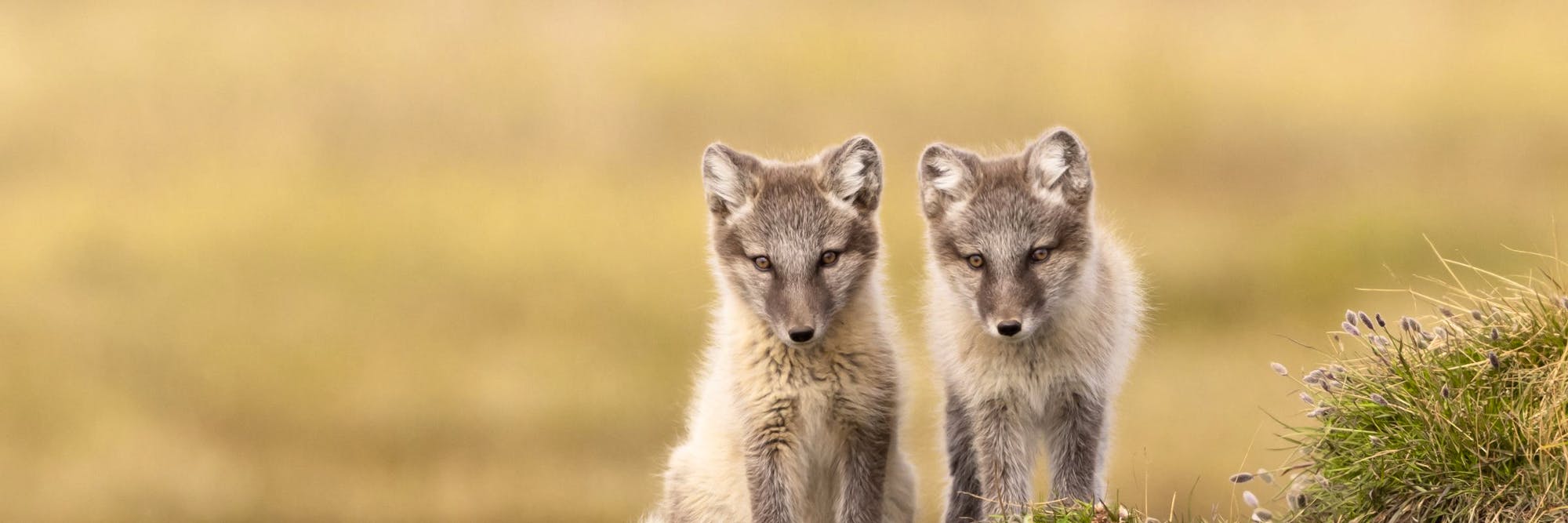
To live in such cold places, Arctic foxes have several adaptations that allow them to survive. Their round, compact bodies minimize surface area that is exposed to the cold air. Their muzzle, ears, and legs are short, which also conserves heat.

© Jeffrey Kerby
Diet
Lemmings are the staple food for Arctic foxes. However, they are quite opportunistic, and will eat whatever is available out on the frozen tundra, even if it means scavenging leftovers from other predators, such as polar bears!
Population
Arctic fox populations range in the hundred thousands, but fluctuate with the available lemming population.
Range
Did You Know?
Arctic foxes change the color of their fur with the seasons. In winter they are white to blend in with the snow, while in the summer they change to brown!
The Arctic fox is found throughout the entire Arctic tundra, through Alaska, Canada, Greenland, Russia, Norway, Scandinavia, and even Iceland, where it is the only native land mammal.
Behavior
The tundra is not an easy place to live. It is barren, rocky, and without much vegetation. Arctic foxes are extremely well adapted to their frigid homes, and have secured a niche where they make the best out of almost any situation.
One of the most unique and interesting behaviors of Arctic foxes is how they hunt. They have incredible hearing, aided by their wide, front-facing ears, which allow them to locate the precise position of their prey beneath the snow.
When the Arctic fox hears its next meal under the snow-pack, it leaps into the air and pounces, breaking through the layer of snow right onto the prey beneath.
Reproduction
Mating season for Arctic foxes usually lasts from early September to early May. Litters are usually between 5-9 pups, though much larger litters aren't uncommon. Arctic foxes usually mate for life, and both mother and father help raise the pups.
More on Arctic Fox:
Size: Arctic foxes can range from 2.3 to 3.5 feet (.76 - 1.1m) in length, in addition to their 12-inch (.3m) tail. At the shoulder, they stand around 9 inches to 12 inches (.2 - .3m) tall.
Weight: Arctic foxes range from 6.5 to 21 lbs (2.9 - 95kg). Female Arctic foxes tend to be smaller than males.
Lifespan: Usually around 3 to 6 years.

Click to enlarge »